Strategy
AI Tools for Agencies: Integrating AI into Agency Workflows 2026
AI tools for agencies streamline workflows, boost productivity, and enhance creativity by integrating automation, governance, and data-driven insights across marketing operations.

Benjamin Zenou
CEO & Founder

TL;DR: AI tools for agencies can triple productivity and unlock new revenue streams when integrated correctly. This guide covers 8 proven steps: mapping workflows, integrating with existing stacks, building governance frameworks, implementing quality gates, training teams, measuring ROI, and communicating value to clients. Grounded in NIST frameworks and real agency case studies.
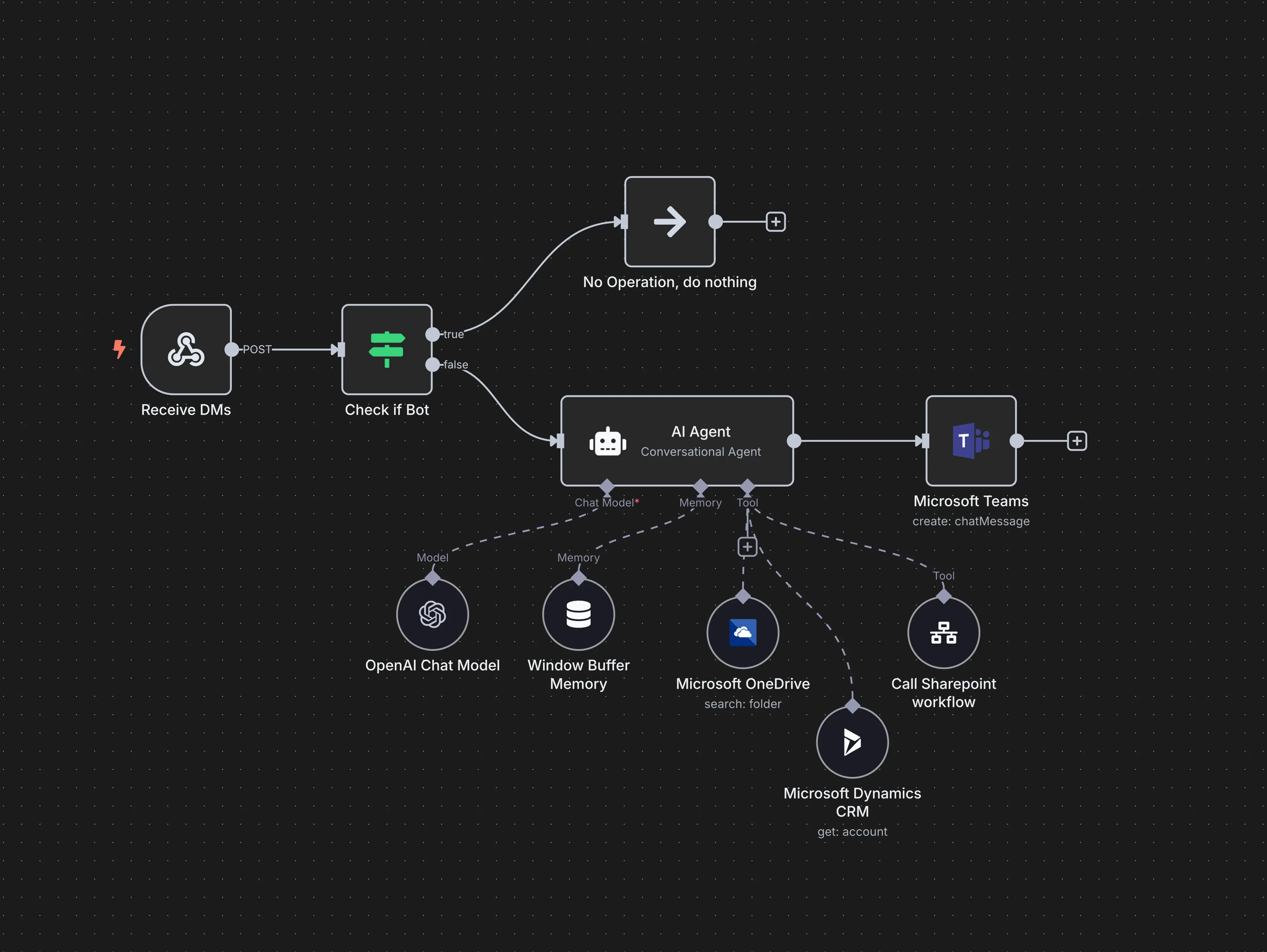
AI workflow automation dashboard showing integrated agency operations
You know the feeling. Another client brief lands with a two-week turnaround, your creative team is stretched thin, and you're wondering: Is there a better way? The answer lies in AI tools for agencies, but success isn't about throwing AI at every problem. According to McKinsey's 2024 research, 65% of organizations now use generative AI regularly, with marketing and sales teams seeing real revenue impact [1]. The difference between those who succeed and those who waste budget? Integration. The winners wire AI tools for agencies into their workflows, not beside them.
This guide walks you through a proven, step-by-step playbook for integrating AI into your agency's existing operations, grounded in real-world moves like Publicis's integration of Adobe Firefly into its CoreAI platform [7], recognized frameworks like the NIST AI Risk Management Framework [5], and compliance realities like the EU AI Act [3]. Whether you're running a $5M boutique or a $50M holding company division, this is your roadmap to scale smarter, deliver faster, and unlock new revenue, without losing what makes your agency unique.
What Are AI Tools for Agencies?
AI tools for agencies are specialized software platforms that automate and enhance marketing, creative, and operational workflows. In 2025, leading agencies use AI for campaign management, content creation, analytics, client reporting, and workflow automation. These tools include:
Generative AI platforms like ChatGPT and Jasper for content creation and research
SEO and analytics tools like Surfer SEO for optimization and performance tracking
Creative suites like Adobe Firefly for image generation and design automation
Comprehensive agency platforms like Suits.ai that integrate multiple AI capabilities into one system
Integrating AI tools for agencies requires mapping existing workflows, selecting compatible solutions, ensuring compliance with frameworks like the EU AI Act, and training teams for adoption. The best AI tools for marketing agencies don't replace human creativity, they amplify it by handling repetitive tasks and freeing teams to focus on strategy and innovation.
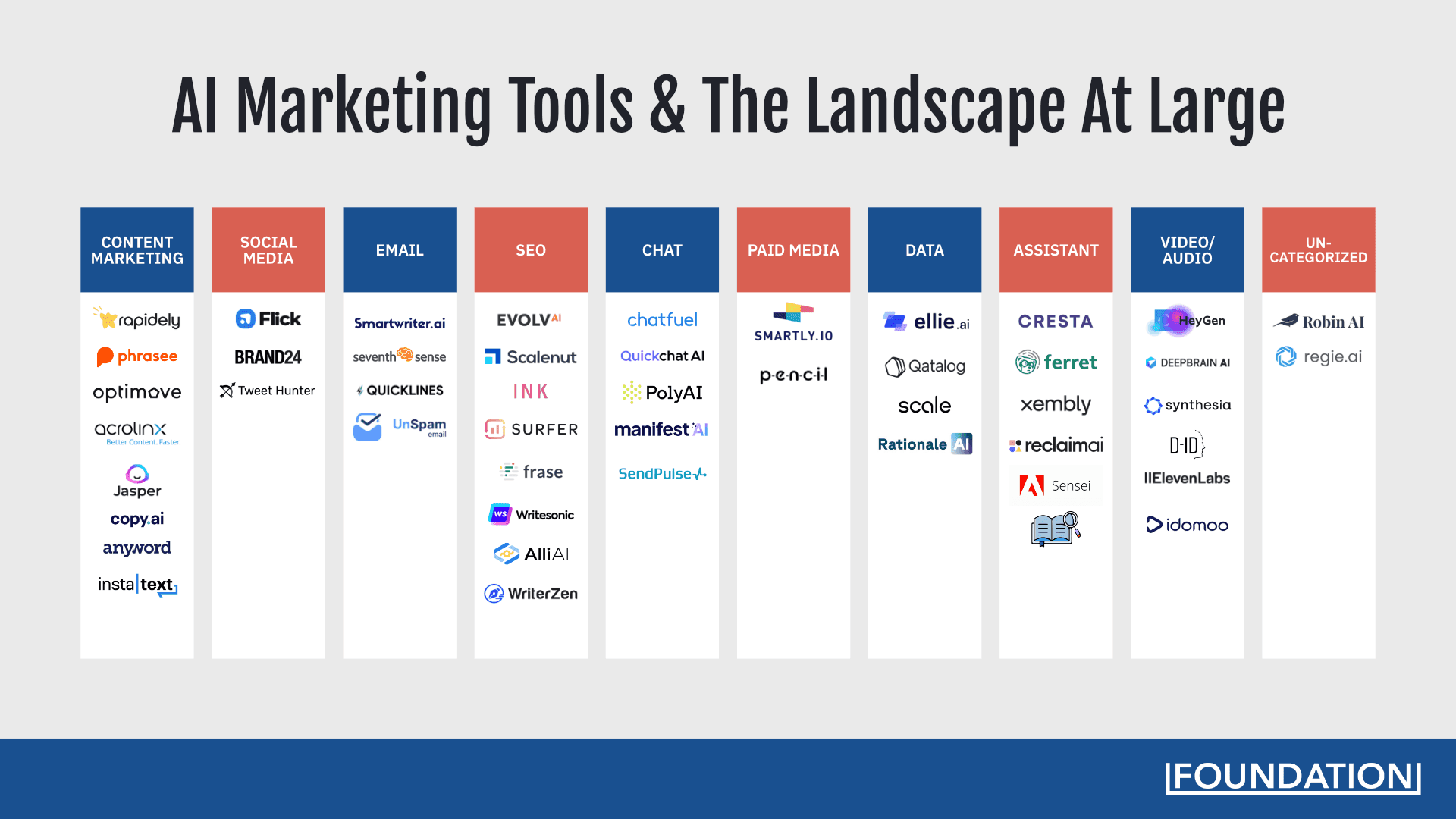
Comprehensive market map of AI tools for marketing agencies in 2025
Step 1: Map Your High-Impact Workflows and Pick Your Pilot
The biggest mistake agencies make? Deploying AI everywhere at once. You end up with a dozen disconnected tools, confused teams, and no clear ROI to show the CFO.
Start by mapping your core workflows: content lifecycle (brief to approval to publish), media operations (campaign setup, trafficking, reporting), analytics pipeline (data collection to insight delivery), client approvals, and QA gates. Get granular. Where does work stall? Where do junior team members spend hours on repetitive tasks? Where does quality slip under deadline pressure?

Typical creative agency workflow from brief to launch
Now pick two or three workflows with clear, measurable outcomes. The best pilots have acute pain points and easy-to-track success metrics. Consider:
Creative versioning: How long does it take to go from brief to first draft? How many hours do you spend localizing one campaign into five markets or creating A/B variants for paid social?
Paid social copy generation and UTM tagging: Can you cut the time to produce 20 ad variants from two days to two hours?
Client research and brief synthesis: What if your strategists could pull competitive intel, audience insights, and brand guidelines into a single brief in 30 minutes instead of half a day?
Report automation and insight extraction: How much time do account managers spend copying data from dashboards into slide decks?
McKinsey's data shows marketing and sales derive meaningful value from gen AI, these are proven pilot areas [1]. The 2024 State of Marketing AI Report confirms rising usage in content creation, personalization, and analytics [2].
Here's where Suits.ai changes the game. Instead of one-off experiments, the platform's workflow automation captures your agency's methodologies and turns them into AI agents that learn your firm's DNA. Your pilots become scalable, repeatable systems, not science projects that die after the first sprint.
Step 2: Integrate AI Tools for Marketing Agencies Inside Your Existing Stack
Don't ask your team to jump between tools. They already live in your DAM, CMS, AdOps platform, CRM, analytics suite, project management system, and Slack or Teams. If AI sits outside that ecosystem, adoption dies.
The model to follow? Publicis integrated Adobe Firefly directly into its CoreAI platform to drive creative expression and personalization at scale within existing creative and marketing suites [7] [8]. This is "AI inside the workflow," not a side tool your team has to remember to open.
In practice, this looks like:
AI agents pull client briefs from your project management tool, generate first drafts in your CMS, and route them for approval in Slack, no manual handoffs.
Creative ops teams use AI versioning tied directly to your DAM, with brand guidelines and asset metadata automatically applied to every output.
Analytics dashboards surface AI-generated insights in real time, no CSV exports, no pivot tables, no slide deck assembly required.
Best AI Tools for Agencies: Comparison Table
Tool | Best For | Key Features | Pricing | Integration Options |
|---|---|---|---|---|
Suits.ai | Comprehensive agency platform | Multi-model AI, workflow automation, client intelligence, 24/7 AI agents | Custom enterprise pricing | 50+ tools, Google Drive, SharePoint |
Jasper | Content creation | Brand voice training, templates, SEO optimization | $49–$125/month per user | Chrome extension, API |
Surfer SEO | SEO optimization | Content editor, keyword research, SERP analyzer | $89–$219/month | Google Docs, WordPress |
Adobe Firefly | Creative generation | Image generation, style matching, commercial safety | Included with Creative Cloud | Adobe Creative Suite |
Notion AI | Workflow automation | Document generation, task management, knowledge base | $10/month per user | Notion workspace |
ChatGPT Plus | Research & drafting | Conversational AI, web browsing, custom GPTs | $20/month per user | API, plugins |
Suits.ai makes this seamless. The platform integrates with 50+ tools and connects directly to Google Drive and SharePoint for real-time updates. Your AI agents understand client context, brand voice, and SOPs from day one, so outputs are hyper-relevant without manual tuning. You're not bolting on another tool, you're amplifying the stack you already have.
Step 3: Build Guardrails with Recognized Risk Frameworks
Speed without guardrails is a recipe for brand risk, compliance exposure, and client trust issues. Set controls early so you can scale confidently.
The framework to use is the NIST AI Risk Management Framework (AI RMF) and its Generative AI Profile, published in 2024 [5]. It defines how to handle model selection, pre-deployment testing, content provenance, disclosure policies, incident handling, monitoring, and human oversight.
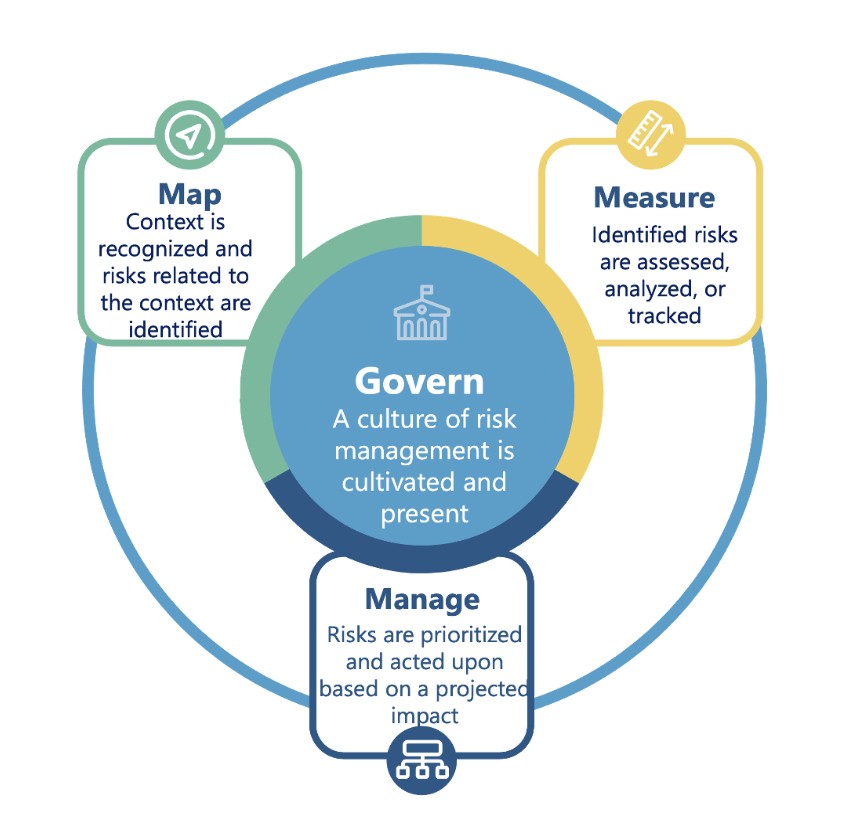
NIST AI Risk Management Framework structure and core functions
Document three things right now:
Which AI models and tools are approved for which use cases. Not every task needs GPT-4. Some need Claude for nuanced writing. Others need a lightweight model for speed. Suits.ai's multi-model approach dynamically selects the ideal model for each task—data analysis, content creation, strategic advice—so you get best-in-class performance without vendor lock-in.
When humans must review. Define QA gates for brand voice, regulated content (health claims, financial advice), IP-sensitive assets (celebrity likenesses, copyrighted images), and high-stakes client deliverables. Log every AI-assisted decision so you can audit and improve.
How you track safety metrics. Monitor policy violations, hallucination rates, copyright flags, and incident response times. If an AI output goes off-brand or off-script, you need to know within hours, not after the client sees it.
This isn't theoretical. The EU AI Act, adopted in July 2024, includes phased obligations starting February 2, 2025 (prohibited practices and AI literacy requirements) through August 2, 2025 (general-purpose AI obligations) [3] [4]. Aligning with NIST now reduces rework when you roll out to more teams or geographies.
Suits.ai is SOC 2 Type 2 certified, built on Google Cloud with enterprise-grade protection, and ensures client data never trains external models. Your governance policies are enforceable at the platform level, not just on paper.
Step 4: Stand Up an AI Management System (ISO/IEC 42001)
Think of ISO/IEC 42001 as your operating manual for AI: roles, documentation, risk controls, supplier oversight, monitoring, and audits. It aligns with both the NIST AI RMF and the EU AI Act, so you run one governance program that meets multiple regulatory and client audit needs [6].
Set up four things:
Roles: Who owns AI strategy? Who manages risk? Who handles vendor contracts and incident response? Assign names, not just titles.
Documentation: Build a model inventory, use-case register, risk assessments, testing logs, and deployment records. Start with a lightweight "AI playbook" document and evolve it as you scale.
Supplier oversight: Run vendor due diligence. Negotiate contract terms around data use, IP ownership, and liability. Monitor performance and compliance quarterly.
Continuous improvement: Schedule regular audits, incident reviews, and policy updates. AI changes fast—your governance needs to keep pace.
Suits.ai's multi-model approach means your management system covers multiple AI vendors under one roof, simplifying oversight and audit trails. You're not chasing down five different vendor SOC 2 reports, you're managing one platform with enterprise-grade controls.
Step 5: Put Humans in the Loop with Clear QA Gates
AI accelerates work. Humans ensure quality, brand voice, and compliance. The trick is defining exactly when and how humans review, so you're not bottlenecking every output, but you're also not shipping work that misses the mark.
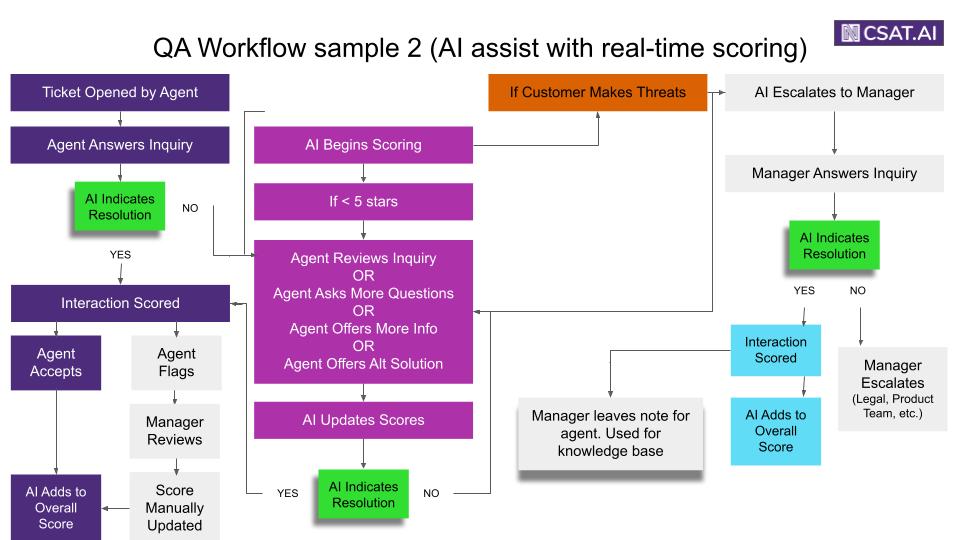
QA workflow with AI assistance and human review gates
Gate these areas:
Brand voice and tone: Creative directors review AI drafts before client presentations. AI can nail the structure and speed, but your team brings the nuance that makes work unmistakably yours.
Claims and regulated content: Legal or compliance teams review any health, financial, or legal claims. One hallucinated statistic can cost you a client, or worse, a lawsuit.
IP-sensitive assets: Check for copyright, trademark, or likeness issues before anything goes live. AI doesn't know that your client's competitor owns the rights to that stock photo.
High-stakes decisions: Strategy recommendations, budget allocations, and client-facing insights get human sign-off. AI can surface the data; your expertise turns it into a recommendation worth acting on.
Log which outputs were AI-assisted, who reviewed them, and what changes were made. This supports audits and helps you improve over time. The NIST Generative AI Profile emphasizes pre-deployment testing, human oversight, and incident response, use these as your QA blueprint [5].
Suits.ai's AI agents act as 24/7 team members, up to speed on the latest client details and SOPs. But final decisions and creative judgment stay with your experts, so you scale capacity without sacrificing quality or losing the creative spark that wins you business.
Step 6: Train Your Teams and Clients on AI Literacy
The EU AI Act includes AI literacy expectations [4], and clients increasingly ask how you use AI. Proactive training builds confidence and reduces risk.
For your team, cover prompting techniques, bias awareness, data handling, when to escalate issues, and disclosure protocols. Use role-based workshops, lunch-and-learns, recorded modules, and quick-reference guides. Show real examples from your pilots, before-and-after cycle times, quality scores, cost savings.
For clients, explain how AI enhances your work (speed, versioning, rapid testing), where humans add value (strategy, big ideas, compliance judgment), and how you protect their data. Transparency builds trust. Use provenance tags and clear scopes in proposals and deliverables.
Here's the advantage: Suits.ai requires no prompt engineering skills. Your team focuses on strategy and creative judgment, not wrestling with complex AI syntax. That lowers the training barrier and accelerates adoption across junior and senior staff alike.
Step 7: Measure What Matters: Speed, Cost, Quality, and Safety
AI is a process improvement that must earn its keep. Track the metrics that matter to your P&L and your clients.
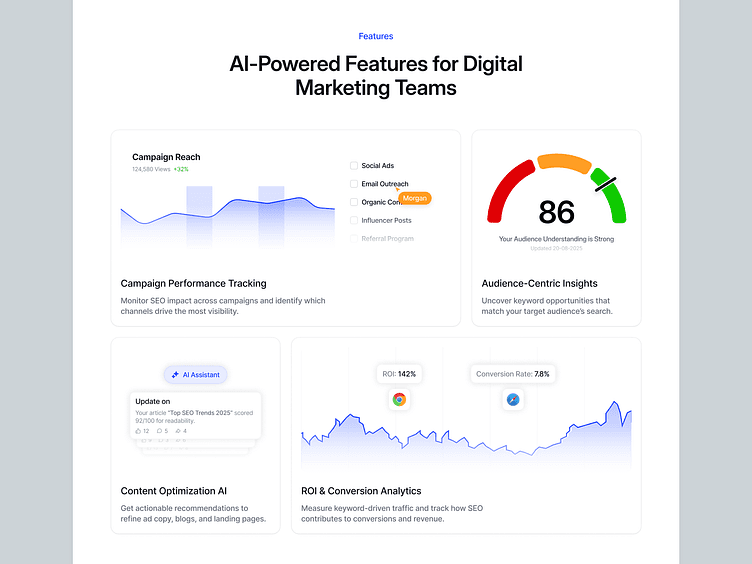
AI marketing dashboard showing campaign insights and ROI analytics
Measure four things:
Speed: Cycle time from brief to first draft, approval to publish, time saved per week per team member.
Cost: Production cost per asset, cost per campaign, labor cost reduction.
Quality: Human-rated creative quality, client satisfaction scores, conversion lift, engagement metrics.
Safety: Policy violations, copyright flags, hallucination rate, incident count, time to resolution.
Build dashboards in your analytics platform. Tie AI usage data to project outcomes. Run A/B tests comparing AI-assisted work to manual processes. McKinsey's research shows that organizations seeing revenue impact from gen AI are those that measure and optimize relentlessly [1].
Common Challenges and Solutions
Challenge: High upfront costs
Solution: Start with free or low-cost tools (ChatGPT, Gemini) for pilots. Demonstrate ROI in 2–3 months before scaling to enterprise platforms. Most agencies see 30–50% time savings within the first quarter.
Challenge: Team resistance and training time
Solution: Focus on high-pain workflows first. Show quick wins. Use platforms like Suits.ai that require no prompt engineering. Provide role-based training, not one-size-fits-all.
Challenge: Data security concerns
Solution: Choose SOC 2 Type 2 certified platforms. Verify client data isn't used for model training. Implement clear data handling policies and audit trails.
Challenge: Maintaining creative quality
Solution: Use AI for speed and scale, humans for strategy and brand intuition. Define clear QA gates. Track quality metrics alongside speed and cost.
Suits.ai's AI agents continually surface critical insights and market intelligence, and the platform's integration with 50+ tools means you can pull performance data directly into your reporting workflows, no manual CSV wrangling, no end-of-quarter scrambles to prove ROI.
Step 8: Communicate Value and Limits to Clients
Clients want to know how AI helps, and where your human expertise still drives the magic. Transparency builds trust and differentiates you from competitors who treat AI like a black box.
Tell clients three things:
Where AI helps: Speed (faster drafts, more variants, rapid testing), scale (personalization at volume), and insight (data synthesis, trend spotting).
Where humans matter: Strategy, big creative ideas, brand intuition, compliance judgment, and relationship management. AI doesn't replace the late-night brainstorm that cracks a campaign, it frees up time so your team can have more of them.
How you protect their data: SOC 2 certification, data separation, no model training on client content. Suits.ai ensures each firm's data remains completely separate and protected, so clients know their competitive intelligence stays confidential.
Use provenance tags and transparent scopes in your proposals and deliverables. Show clients the "AI-assisted" label and explain the review process. The NIST guidance and EU AI Act disclosure rules support this transparency [3] [5].
Suits.ai's AI agents speak your firm's language and reflect your brand's personality, so clients experience your expertise, amplified by AI, not generic machine output. That's the difference between a vendor and a partner.
Turn Integration into a Competitive Edge
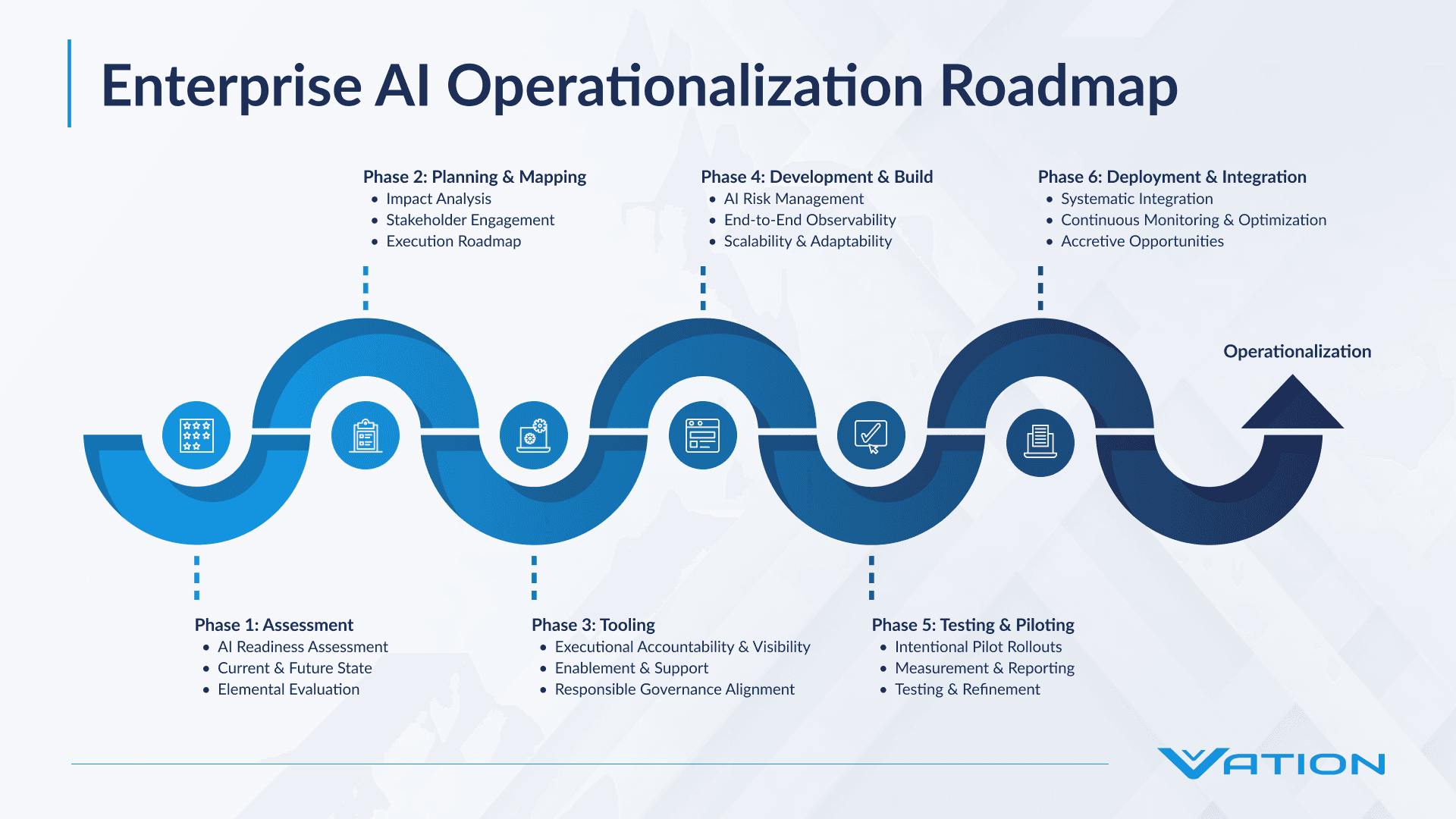
Strategic roadmap for AI operationalization in agencies
You've mapped workflows, integrated AI inside your stack, built governance frameworks, gated with human QA, trained your teams, measured outcomes, and communicated transparently with clients. The payoff? Faster delivery, lower costs, higher quality, and new revenue streams, like AI-powered subscription apps for clients that turn one-off projects into recurring revenue.
Agencies that integrate AI the right way, grounded in frameworks, wired into workflows, and amplifying (not replacing) human expertise, will scale faster and win bigger than those treating AI as a side experiment. You'll pass enterprise audits, meet compliance deadlines, and deliver work that clients can't get anywhere else.
Start with one pilot workflow this week. Use the NIST AI RMF as your guardrail checklist. And explore how Suits.ai can turn your agency's methodologies into AI agents that scale your best work and multiply your revenue, without losing your creative edge or your brand identity.
Frequently Asked Questions About AI Tools for Agencies
What are the best AI tools for agencies in 2025?
Top AI tools for agencies in 2025 include Suits.ai (comprehensive agency platform), Jasper (content creation), Surfer SEO (SEO optimization), Notion AI (workflow automation), Adobe Firefly (creative generation), and ChatGPT (research and drafting). The best choice depends on your agency's specific needs, creative shops prioritize generative tools, while data-driven agencies focus on analytics and automation platforms.
How much do AI tools for agencies cost?
AI tools for agencies range from $20/month per user for basic tools like ChatGPT Plus to $500–$2,000/month for enterprise platforms like Suits.ai. Most agencies spend $200–$800/month per team member when combining multiple tools. ROI typically appears within 2–3 months through time savings and increased capacity.
How long does it take to integrate AI tools into agency workflows?
Basic integration takes 2–4 weeks for pilot workflows. Full agency-wide adoption typically requires 2–3 months, including training, governance setup, and process refinement. Agencies using platforms like Suits.ai with pre-built integrations can accelerate timelines by 40–50%.
Are AI tools for agencies compliant with data privacy regulations?
Reputable AI tools for agencies offer SOC 2 Type 2 certification, GDPR compliance, and EU AI Act alignment. Always verify that client data is not used for model training, data remains encrypted, and the vendor provides clear data processing agreements. Suits.ai, for example, ensures client data never trains external models and maintains complete data separation.
Can small agencies afford AI tools?
Yes. Many AI tools offer tiered pricing starting at $20–$50/month. Small agencies can start with free tools (ChatGPT, Gemini) and gradually add specialized platforms as ROI is proven. Focus on high-impact workflows first (content creation, reporting) to demonstrate value quickly.
Do AI tools replace creative agency staff?
No. AI tools for agencies augment human creativity and efficiency rather than replace staff. They handle repetitive tasks (versioning, formatting, data synthesis), freeing creative teams to focus on strategy, big ideas, and client relationships. Leading agencies use AI to scale capacity 2–3x without increasing headcount.
How do I measure ROI from AI tools for agencies?
Track four key metrics: (1) Time savings (hours per week per team member), (2) Cost reduction (production cost per asset), (3) Quality improvement (client satisfaction scores, conversion lift), and (4) Revenue impact (new service offerings, increased capacity). Most agencies see 30–50% time savings within the first quarter.
By Benjamin Zenou Marketing Technology Strategist
Benjamin Zenou has led AI integration projects for 15+ marketing agencies, including Suits.ai.
Sources
[1]: The state of AI in early 2024: Gen AI adoption spikes and shows potential
[3]: Regulation (EU) 2024/1689 (EU AI Act) – Official Journal
[5]: Artificial Intelligence Risk Management Framework: Generative AI Profile (NIST.AI.600-1)
[8]: Publicis Groupe and Adobe Expand Global Partnership (Press Release)